Title
What Codex Alera showed me about creativity, power, and what we build
We tend to imagine creativity as a lightning strike. What it leaves out is how most new things actually get made.
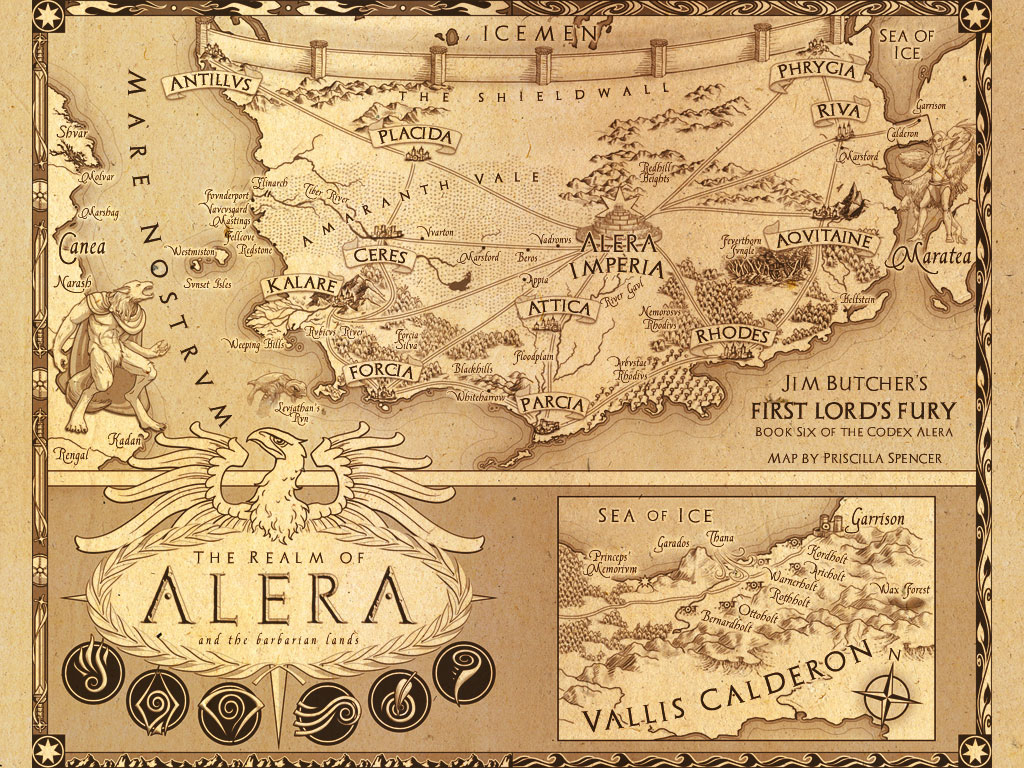
Essay
Fantasy is the genre I return to most, and lately I’ve noticed I read it the way I read most things now: as someone building a company. Fantasy writers face a problem founders — and marketers — know well. They work with materials every reader has seen before, like elemental magic, a reluctant hero, and an empire under strain, and they have to arrange them into something that feels new.
Over the past month, I reread Jim Butcher’s Codex Alera. I first read the series 12 or 13 years ago and went in remembering almost nothing, so it felt close to a first read. This time, I read it with two questions in mind.
- How do writers make something original out of familiar parts?
- How do the worlds they build decide whose abilities get recognized and whose get missed?
In Alera, magic answers both. People use it to farm, heal, and fight, and because it runs through everyday life, it sets the terms for who holds power, whose work counts, and what everyone expects of one another.
Tavi, the protagonist, has no magic at all. Most people around him conclude he has little to offer, and the series spends six books showing how wrong they are. When an extraordinary ability becomes common, it tends to become the yardstick for everyone. Alerans are so used to solving problems with magic that they struggle to picture what someone without it could contribute.
Companies build teams the same way. Every industry settles on a set of abilities it expects, rewards the people who have them, and can miss the people who reach the same outcome by a different route. As a founder, I think about that every time I decide what kind of talent to look for.
To understand how those expectations take hold in Alera, it helps to look at how the world and its magic fit together.
The question every world is built on
The fantasy worlds that stay with us have something in common, even if it’s hard to name at first. Everything in them is connected. When something changes in one corner of the world, the effects eventually show up somewhere else.
That’s worldbuilding at its best. A writer invents history, geography, cultures, politics, and the texture of daily life, and the world comes alive the moment those pieces start leaning on each other. A drought raises the price of bread, the price of bread starts a riot, and the riot topples a king.
A magic system is one of the pieces with the most reach. It sets the rules for who can use magic, what it can do, and what it costs. Once those rules exist, they spill into everything else. If magic can heal a broken leg, who gets healed first? If it can grow crops on rocky soil or win a war, what happens to the people who can’t use it?
Underneath all of this sits one question: if this were possible, what else would change? Ask it about almost anything, and you start to see how much a world rests on its foundations:
- If magic can heal serious injuries, what happens to medicine, to war, and to people who can’t afford a healer?
- If a kingdom fears magic, who enforces the ban, and who profits from breaking it?
- If a mountain range splits two peoples, how does it shape what they trade, how they speak, and why they fight?
- If everyone believes a prophecy, how might a ruler or a rebel use that belief to gain power?
Founders run into a version of this all the time. Whenever a new technology becomes cheap enough for everyone to use, I pay attention to what reorganizes around it: who gains leverage, whose work changes, and which old assumptions stop holding up.
In Codex Alera, the foundation is furycrafting, and Butcher follows it all the way through. Alerans bond with furies, elemental spirits of earth, air, fire, water, wood, and metal. Earthcrafters pull harvests from the ground, watercrafters heal wounds that would kill anyone else, and windcrafters fly. Furycrafting decides how people earn a living, who rules the great cities, and what a person is worth.
The Pokémon problem: Why recombination is the most honest account of creativity

Codex Alera began with an argument between writers. Butcher had argued that a good writer could turn almost any premise into a worthwhile story, and another writer challenged him to prove it. Butcher accepted, then asked for a second bad idea on top of the first.
Finally this guy on the other side said “Why don’t you put your money where your mouth is? Why don’t you let me give you a bad idea and let’s see you write it into a worthwhile story?”
Being young and dumb and kinda mouthy, I wrote him back “I tell you what, why don’t you give me TWO bad ideas and I’ll use them both.” The guy says “okay— the first bad idea I want you to use is the ‘Lost Roman Legion’—I am so sick of Lost Roman Legion stories—all lost roman legions should have been found by now. So that’s the first one, lost Roman legion.”
I said “okay, what’s the second one?”
He says “Pokémon.”
This story challenges one of our most persistent beliefs about creativity.
We tend to imagine creativity as a lightning strike, where a lone genius stares at a blank page until something entirely new appears. The image lasts because it makes creativity feel rare and makes creative people feel special. What it leaves out is how most new things actually get made.
Butcher began with two ideas his readers already knew well. His real invention was the relationship between them. Once a Roman legion and a world of elemental creatures were placed side by side, the questions followed naturally.
- What happens when elemental powers become essential to farming, healing, construction, and war?
- How would the descendants of a Roman legion organize a society around those powers?
- Who rises, and who gets left behind?
Answer enough of those questions, and you have a civilization.
Recombination runs through every craft
The same pattern shows up wherever people make things:
- A chef combines flavors from two cuisines and ends up with a dish neither tradition could produce alone.
- An architect studies how termites keep their mounds cool and designs a building that needs very little air conditioning.
- A producer sets an old soul sample under a modern beat, and a sound we’ve heard many times feels new again.
- A founder takes a workflow that already works in one industry and rebuilds it for another.
In each case, the creative work is noticing that two existing things belong together, and having the conviction to put them side by side. An argument was all it took to get Jim Butcher to write a bestselling series. Seriously.
In defence of tropes
I should say up front that this isn’t one of the best series I’ve ever read. It has strengths, but it also has the flaws you’d expect from a writer still finding his footing in a new genre.

For all the strangeness of its premise, Codex Alera follows some familiar fantasy patterns. A young man from a rural background turns out to be more than he appears. An empire faces corruption from within and threats from outside. Old enemies have to become allies. A destiny reveals itself a little at a time.
You can probably name a few other series from that description, and so can I. But familiarity has never been enough to turn me away from a good story.
Tropes last because they capture patterns that keep showing up in human experience. The lost kingdom, the reluctant leader, and the magic that comes at a price tell us what kind of emotional ground we’re on before we know any of the details. They work like a shared vocabulary between writer and reader. The writer gets expectations to work with, and the reader gets something to look forward to.
That’s why “it’s tropey” rarely tells me much on its own. When someone says it, I want to know what actually bothered them. Maybe the characters felt flat, the plot felt predictable, or they had read the same story too many times. Those are fair complaints, but each one is about how the tropes were handled. Using tropes, on its own, doesn’t make a writer lazy. A better test is what the writer did with the tropes they chose.
In Alera, Butcher sets the familiar hero’s journey in a society that has already judged Tavi by the one thing he can’t do. Before we learn what he might become, we see how people treat him when they think he amounts to very little. That gives me a reason to care about his story, even when I can guess where parts of it are heading.
Familiar tropes also free up the reader’s attention for what is new. Because the shape of the story is easy to recognize, most of the effort goes into learning how this particular world works.
Fantasy reading is not passive. A reader who enters Alera must learn the fury system well enough to understand what characters can and cannot do, what victories cost, what defeats mean.
The reader mentally simulates the world. They predict consequences. They notice when the system’s rules are violated.
They compare the fictional political structure with real political structures and ask whether they are different and whether they should be. This is imaginative reasoning. It is closer to thinking than it is to entertainment, even when it is also entertainment.
The tropes make this reasoning accessible. They establish baseline expectations that the writer can then use, complicate, or subvert in ways that reveal something. For Alera, the obvious comparison is Rome.
What Alera borrows from Rome
Alera owes a great deal to Rome. The society descends from a lost Roman legion, and the resemblance runs through its government, its military, and its social order. There is a First Lord, a Senate, powerful houses competing for influence, a class of citizens, and an institution of slavery.
What Butcher borrows most deeply is Rome’s set of rules about who belongs and who gets power.
Alera has citizenship because Rome had citizenship, and in Rome, citizenship was a political privilege. It decided who had full protection under the law, who could vote, who could serve in the legions, and who was left outside all of that.
When Alera inherits that system, it raises questions we recognize from the real world:
- Who belongs, and who is kept out?
- What does a person have to do or be in order to be included?
- What does the state owe its citizens, and what do citizens owe the state?
These questions are as old as Rome, and none of them has a settled answer. By borrowing Rome’s rules, Butcher brings those questions into Alera without having to spell them out. Readers recognize the structure, and the distance of a fantasy world makes it easier to look at that structure with fresh eyes.
Every society, and every organization, inherits its rules about belonging from somewhere. Building a company means deciding many of those rules for the first time, like who gets hired, whose work gets recognized, and who gets a say in the key decisions.
Furycrafting is the miracle that became ordinary
By the time the series opens, furycrafting is unremarkable to the people of Alera. Children grow up with it, and nobles take their gifts for granted. What would look like a miracle to us is simply how things get done there.
That convenience comes with a cost: it gives people fewer reasons to invent alternatives. When watercrafting can heal a wound, nobody has much reason to study medicine. When earthcrafting can raise a wall, there’s little pressure to improve engineering. Alera rarely develops the technologies other civilizations depend on, because it has never needed them.
An ability or two can be so useful that people stop asking what else might work. Over time, “this is how we do it” turns into “this is how it’s done.”
We don’t think about the electrical grid while the lights are on, or about servers while a page loads. We rarely think about the supply chains behind our food, our phones, or our fuel. We usually notice them only when something stops working, and that’s when we realize how few alternatives we have.
Tavi never had the usual solution available, so he keeps asking the question everyone else gets to skip: how could this be done without magic?
Anyone building a product takes that question seriously, especially now that AI agents can take on so much of the work. The best products make work easier while still leaving people with a clear sense of how the work gets done.
The boy without power and what he teaches us
I, and possibly you too, know what it feels like to be surrounded by people who seem fluent in something I’m still learning. A certain kind of confidence can look effortless in others and feel like a performance when I try it. Tavi lives with a much harsher version of that feeling.

Without the expected power, he builds other strengths. He’s highly observant, because he can’t afford to miss anything. He learns to improvise, because everyone else’s standard approach, magic, rarely works for him. He builds relationships with people who have the abilities he lacks, and with people who, like him, have learned to move through a world that wasn’t designed for them.
I don’t think hardship automatically makes someone resourceful, and Tavi’s story doesn’t pretend otherwise. Being underestimated costs him, again and again. But the cost runs both ways. The people who dismiss him lose something too, because they overlook someone who can solve problems they’ve never had to approach any other way.
That two-sided downside comes from a pattern that reaches well beyond Alera. Societies often mistake conformity for competence. People who do the expected thing with confidence rise quickly, and people whose abilities don’t fit familiar categories stay invisible until someone needs exactly what they can do.
Creativity usually lives in that gap: the space between what a society rewards and what it actually needs. Seeing that space takes two things at once. You have to understand the world well, and you have to stand slightly outside it.
Tavi can see Alera’s edges because he has never been able to take its center for granted.
The same is true outside fiction. Small teams often have a version of this advantage. Because they can’t run the standard playbook at full scale, they learn which parts of it actually matter, and they find routes that larger teams rarely need to look for.
Leadership when there are no good options
The magical battles in Codex Alera are spectacular, but the political decisions in the middle books are what give the series its weight. Captain’s Fury and Princeps’ Fury in particular put characters in front of choices that don’t resolve cleanly.
Alera faces wave after wave of invasion from nonhuman enemies. That pressure pushes its leaders to centralize authority, set aside legal protections, and make decisions that would be unthinkable in peacetime. The series doesn’t present those decisions as simply heroic. It shows survival under extreme conditions as compromised, costly, and never fully forgivable.
Again and again, the books ask whether an emergency justifies concentrated power. Their answer is that sometimes it does, and that is exactly what makes it dangerous.
- Powers granted in a crisis are rarely handed back in full.
- Alliances formed under threat don’t automatically outlast the threat.
- The trust people give a wartime leader doesn’t automatically carry over to the peace that follows.
Companies go through smaller versions of this. In a crunch, a founder may take over decisions that normally belong to the team, and that is often the right call. The harder part comes afterward, when the crisis has passed and those decisions need to go back to the people who made them before.
Fiction makes this easier to see clearly. Because Alera isn’t our world, we can watch an empire handle a crisis without feeling that we’re picking a side in today’s politics. We can accept that concentrating power is both necessary and corrosive without having to rule on a specific real-world case. In that sense, Alera works like a test environment for political and moral ideas, where you can run the scenario, watch the consequences, and examine your own assumptions with less noise.
What Codex Alera changed for me
I picked this series up again for the stories, and I finished it with three ideas about how good work gets made.
The first is about originality. A lost legion and Pokémon showed me how much new work comes from transforming familiar materials. When you follow inherited ideas honestly, something new can emerge from where they meet.
The second is about constraints. The fury system has six elements, clear rules, and real costs, and those limits are what make the story work. Rules create consequences, consequences force choices, and choices show us who the characters really are.
The third is about technology. Furycrafting reminded me that a technology becomes political the moment someone decides who gets to use it. Every technology carries an argument about whose abilities deserve to be amplified. As someone building one, I try to be clear about who it’s designed for and who it might leave out without meaning to.
What ties these ideas together for me is that the same rules do two jobs at once. The fury system gives Alera its coherence, and it also creates the blind spot that keeps Alerans from recognizing what Tavi can do.
Anything that makes some things easy will make other things hard to see, whether it’s a magic system, a company, or a product. The choices that make a technology work well for one kind of person also shape who it passes over, and the most original ideas often come from the people standing just outside those choices. I try to remember that as we build: the edges of whatever we design are where the next good idea is most likely to come from.