

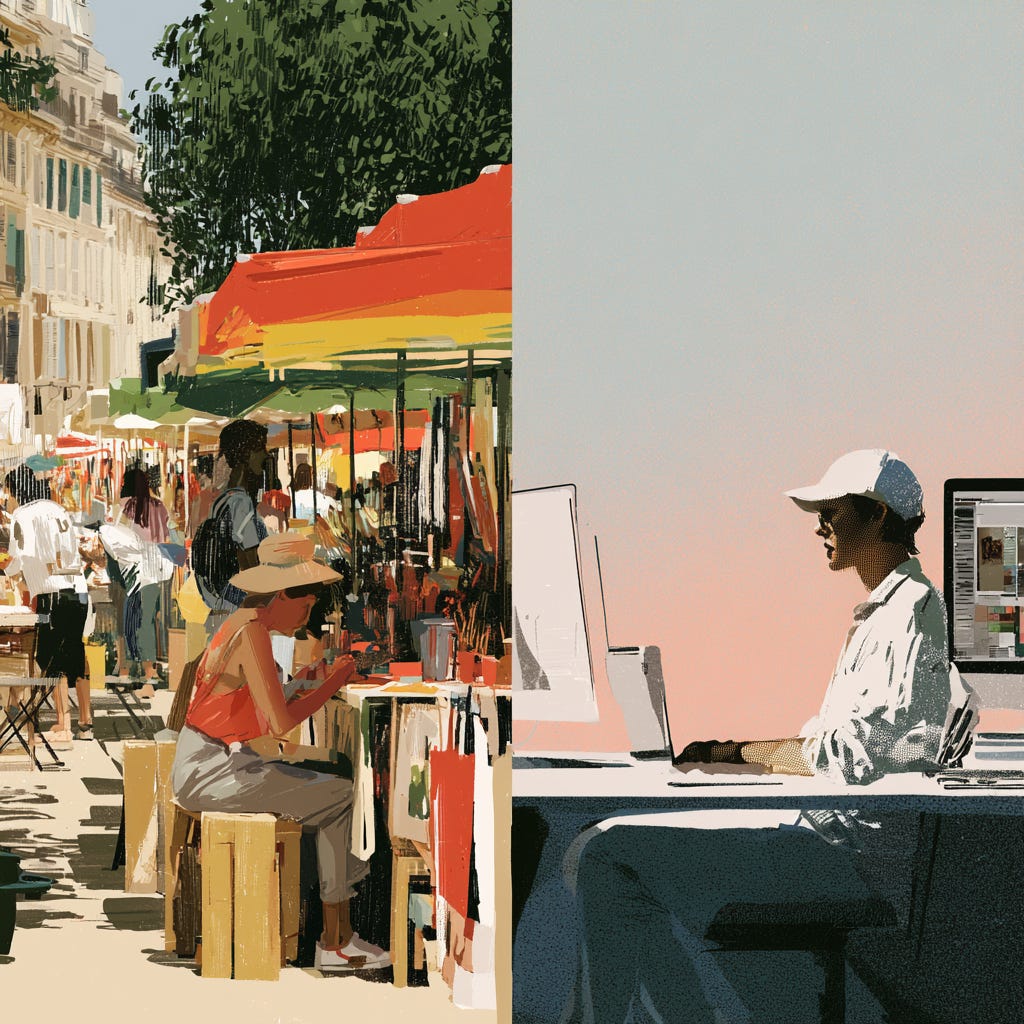
There’s a persistent myth in startup culture that every business is a caterpillar waiting to become a butterfly — that the natural endpoint of a good idea is headcount, venture funding, and eventually an exit.
Artificial intelligence has only sharpened the story. Now, a single person can start the climb faster than ever, but the climb still points the same way: up and out. Under this logic, the person running a lean, profitable one-person operation is either playing small or hasn’t figured out how to scale yet.
That framing gets history exactly backwards.
To see why, let’s rewind past the startup, past the corporation, to the oldest unit of commerce there is: one skilled person selling what they made.
For most of economic history, that was the business model. The blacksmith, the weaver, the cobbler, the potter — each owned a craft, sold directly to the people around them, and built a livelihood on being trusted to do good work.
Then the factory arrived, and mass production made that skilled individual look obsolete. The craftsman retreated, waited for tools to get cheaper, and came back. Every time technology lowered the cost of precision work, solo operators re-emerged and built durable, profitable businesses around mastery rather than mass production.
The digital solo business is the oldest business model in human civilization, running on new legs.
Historically, that model had two hard limits.
One person could produce only so much
They could sell only as far as their reputation travelled
Over time, software weakened the first limit, whereas the internet weakened the second.
Similarly, AI now reduces the coordination and execution work that once forced a successful operator to hire. Which means we should expect to see solo operators scaling further than any craftsman in history.
One-person companies are becoming an economic category
The craftsman is back, and this time the numbers are large enough to name a category. The one-person million-dollar company has become the entrepreneurial story of the moment, and the data backs it up. The Wall Street Journal recently spotlighted solo founders scaling to seven figures with the help of AI. Stripe’s numbers make the trend hard to dismiss: solo businesses crossing $1M in revenue more than doubled from 2023 to 2025, and the $5M and $10M tiers grew nearly 3x over the same period.
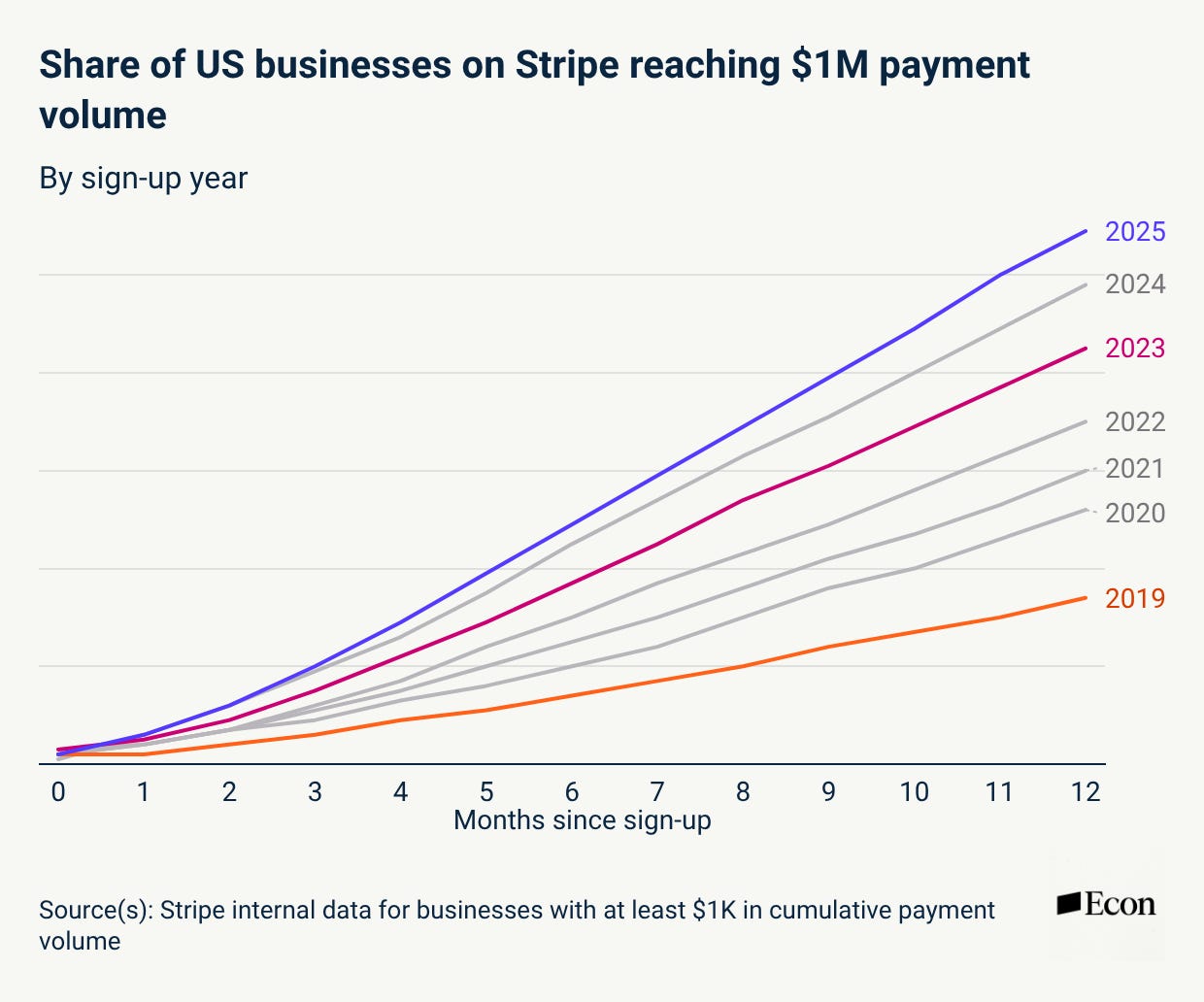
Solo founders made up 63% of all new C-corps formed on Stripe Atlas in Q2 2026 — an all-time high.
The stories are real, the data is real, and the narrative has taken hold: AI has finally set the individual free. That’s the part worth interrogating — because the story being told about why this is happening is mostly wrong, and the real explanation is much older than AI.
The pattern nobody talks about
The standard telling of economic history goes something like this: artisans dominated production before industrialization, factories replaced them, and now we live in a world of corporations and scale. The story ends there, as if the craftsman model was a casualty of progress rather than a recurring character.
Look more carefully and you’ll see a different pattern. Craftsmanship Magazine’s research into the future of handmade work points out that the drift away from craft values isn’t the end of the story — it’s a reaction against systems that reward abstraction over mastery, and reactions have a way of generating their own counter-movements.
The Arts and Crafts movement emerged in the late 19th century precisely because industrialization had devalued skilled work. Studio pottery, furniture making, and textile workshops flourished not despite the industrial economy but as a direct response to its flattening tendencies.
The global arts and crafts market was estimated at nearly $48 billion in 2025 and is projected to reach $87 billion by 2035. The U.S. Alone generates around $51 billion in craft revenue annually, with 71% of American consumers identifying as crafters.
These aren’t hobbyists. This is a market, and a growing one.
The pattern holds: when tools get cheaper and more precise, small-scale quality production becomes economically viable again. A single person with a Riso printer, a laser cutter, or a well-configured software stack can now produce work that once required a full team. That’s not a disruption of the craftsman model. That’s its revival.
Mastery as market position
Most business writing treats the one-person company as a constraint — something you do because you lack the capital or the talent to hire. The craftsman tradition understood something different: the individual as the product isn’t a limitation, it’s a positioning strategy.
Consider Anne Morhauser of Annieglass, who started in a small studio near Santa Cruz and built a glassware brand that ended up in the Smithsonian. Scale never became the point. The point was the work, and the market responded to that quality of attention.
Or take the craftsmen at Northmen in Latvia, who revived medieval woodworking, bladesmithing, and leatherwork into an internationally known operation with waiting lists measured in months. The scarcity wasn’t manufactured by a marketing team. It was organic, because genuine mastery takes years to build and can’t be copy-pasted.
What these businesses share isn’t a lack of ambition. It’s a specific kind of ambition — one oriented around depth rather than volume. The modern solo business runs on the same logic:
Deep expertise that takes years to develop, which means it’s hard to replicate quickly
Personal reputation as the primary asset, which compounds over time
Distribution through trust rather than advertising spend
Tools as force multipliers rather than replacements for judgment
Pricing power that comes from being irreplaceable, not interchangeable
Azeem Azhar calls this the artisan economy path: bootstrapping into durable middle-class wealth through positioning and quality rather than through scale.
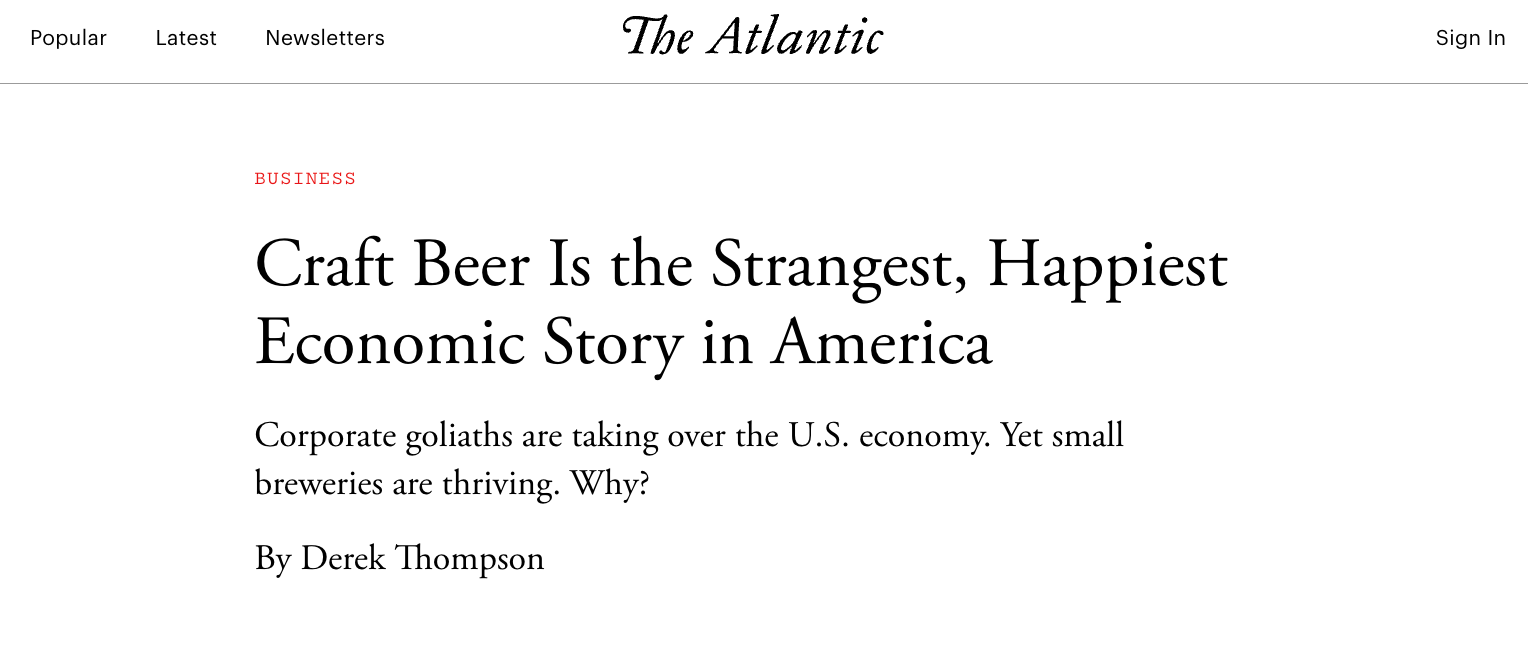
His example is craft beer, and it’s a good one. The craft brewery making $2 million a year with twelve employees isn’t a failed Anheuser-Busch. It’s a different institution operating on a different logic, and most of its founders chose that deliberately.
Why a business needed employees

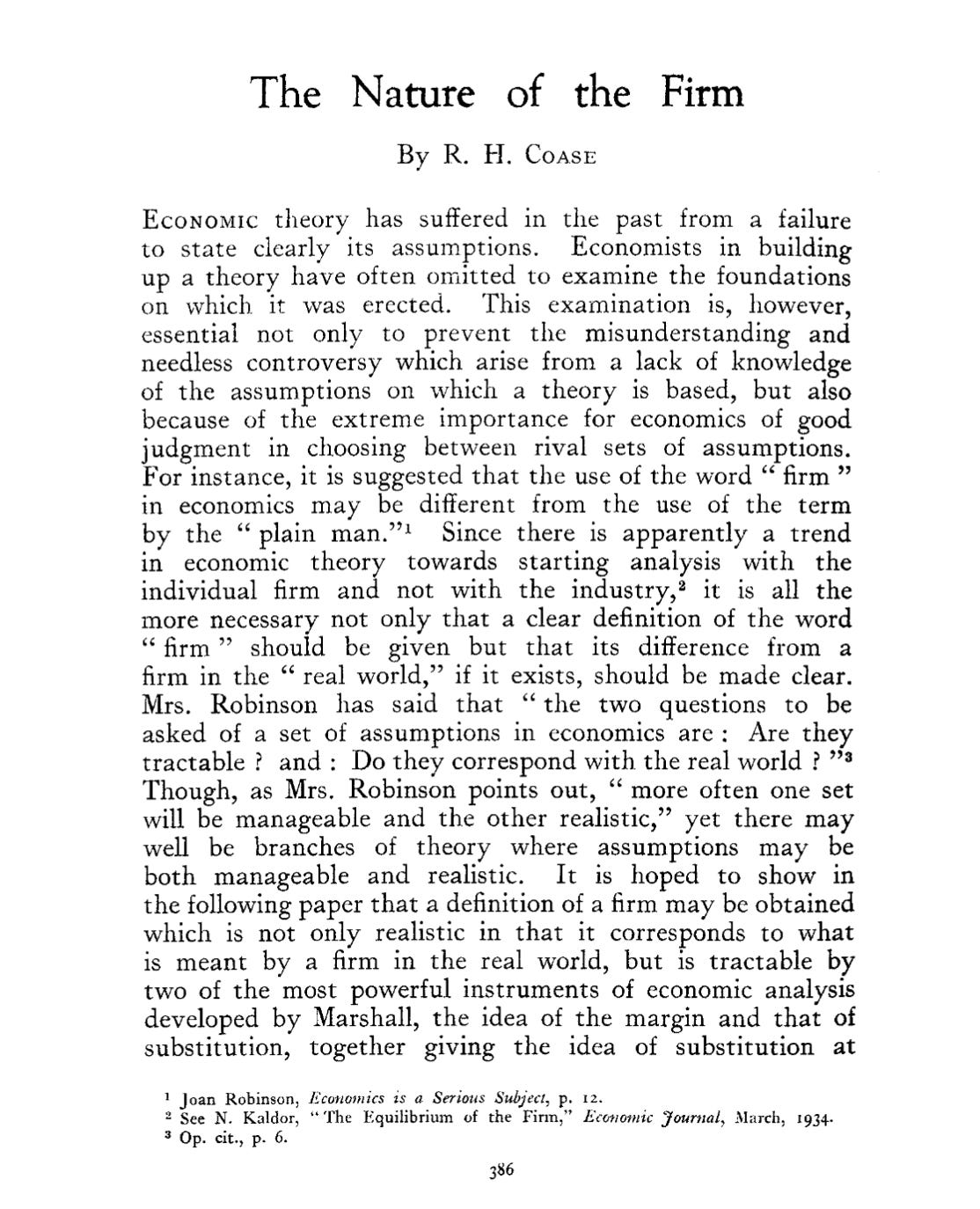
In 1937, economist Ronald Coase asked a question that sounds obvious until you sit with it: why do firms exist at all?
If markets are so efficient, why doesn’t everyone just contract out every task and skip the org chart entirely?
His answer was transaction costs.
Every task you buy on the open market carries hidden overhead — you have to find a supplier, judge whether they’re any good, negotiate a price, and coordinate the handoff. Do that for every function a business needs and the friction adds up fast.
Often it’s simply cheaper to hire someone and bring the work in-house. Firms grew, in other words, because ownership made coordination cheaper than the market did.
The solo business inverts that math. Software has collapsed the cost of administration. Platforms supply distribution and infrastructure you no longer have to own. MakeWorks, for instance, opens up production equipment and technology without forcing a solo operator to become a manufacturer, and global distribution now reaches anyone with an email list and something worth selling.
AI is cutting the cost of producing and coordinating knowledge work itself. Capabilities that used to require a department can now be rented by the hour, or handled by one person with the right machines.
This isn’t a niche phenomenon. Germany’s craft sector alone employs roughly 6 million people across 564,000 enterprises and generates €651 billion in turnover — small businesses organized around mastery rather than mass production, holding a serious share of one of the world’s most advanced economies. The digital craftsman now combines industrial-grade tools, artisan-level judgment, global distribution, and direct customer relationships. That combination has no historical precedent.
In Coase’s terms, the efficient boundary of the firm is shrinking. The million-dollar solo business isn’t possible because one person works like twenty. It’s possible because they no longer need twenty people to reach what twenty people used to provide.
The honest counterargument
Any serious version of this thesis has to reckon with the obvious critique: “craftsman economy” can be aesthetic branding that dresses up fragile economics.
The critics aren’t wrong. The same tools that enable mastery also lower the barrier for everyone else, and cheap access floods a market fast. Skill gets commoditized. Writing, photography, and graphic design all watched it happen — software made quality accessible, and the premium on being good eroded.
The “$1M solo business” ideal hides something less romantic, too. One person is now CEO, salesperson, operator, and support desk at once — with no benefits, no unemployment insurance, and no one to cover when they get sick. The upside has an underside, and it’s exhaustion.
The new-collar framing gets at this. Conceptual, technical, and craft skills are all table stakes in a single role now. That range can liberate you, or it can grind you down. Technology didn’t abolish labor; it raised the bar for how many things one person has to be excellent at simultaneously.
So the model works, but only for specific people in specific categories: knowledge work, niche products, consulting, media, digitally delivered services. It isn’t a universal answer to labor. Calling it one would be its own kind of romanticism.
Growth changes what you do all day
What the critics often miss is that the appeal of the craftsman model was never primarily economic. It was always about identity.
The one-person company is a different institutional form, not a smaller version of something else. The $1M solo business is a statement about values before it’s a statement about revenue. It says:
I want to be excellent at something specific, I want to own my own attention, and I don’t want to manage twenty people to do it. That’s not a failure to think big. That’s a considered answer to the question of what kind of life you’re building.
And this might be the sharpest reframe available: growth is not neutral.
Every founder who scales past a certain point stops doing the work they were originally great at and starts managing the people doing that work. Sometimes that’s the right trade. But it is a trade. The master glassblower who opens a factory has changed professions, not merely expanded one. The craftsman tradition has always known this. Most startup culture still doesn’t.
The $1M solo business that has no intention of becoming a $10M company isn’t stuck. It arrived exactly where it was trying to go.