


Disclaimer: The thoughts and theories expressed in this article represent solely the intellectual opinions of the author. This work is an unofficial, speculative essay and is not intended to be considered official canon.
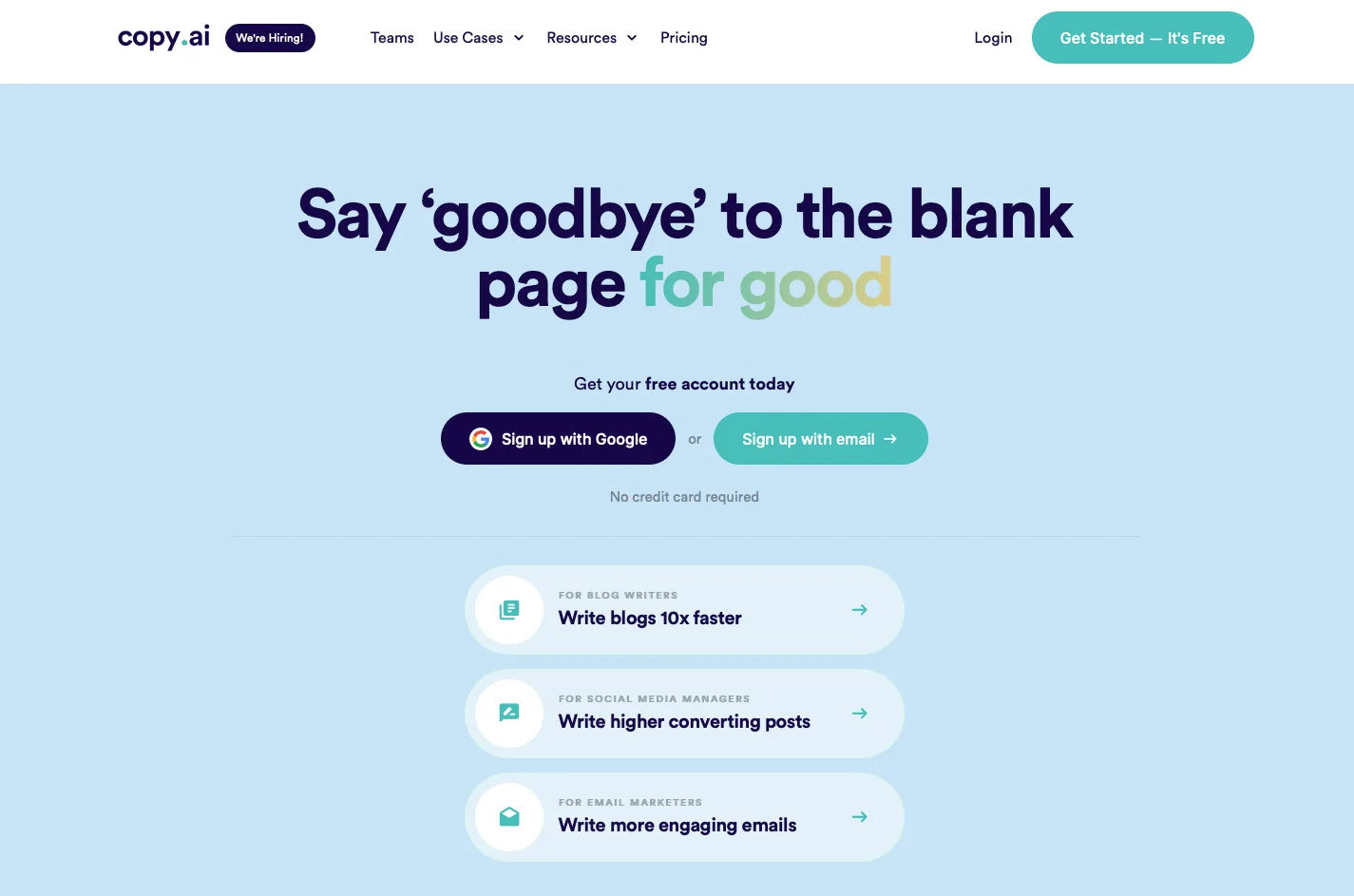
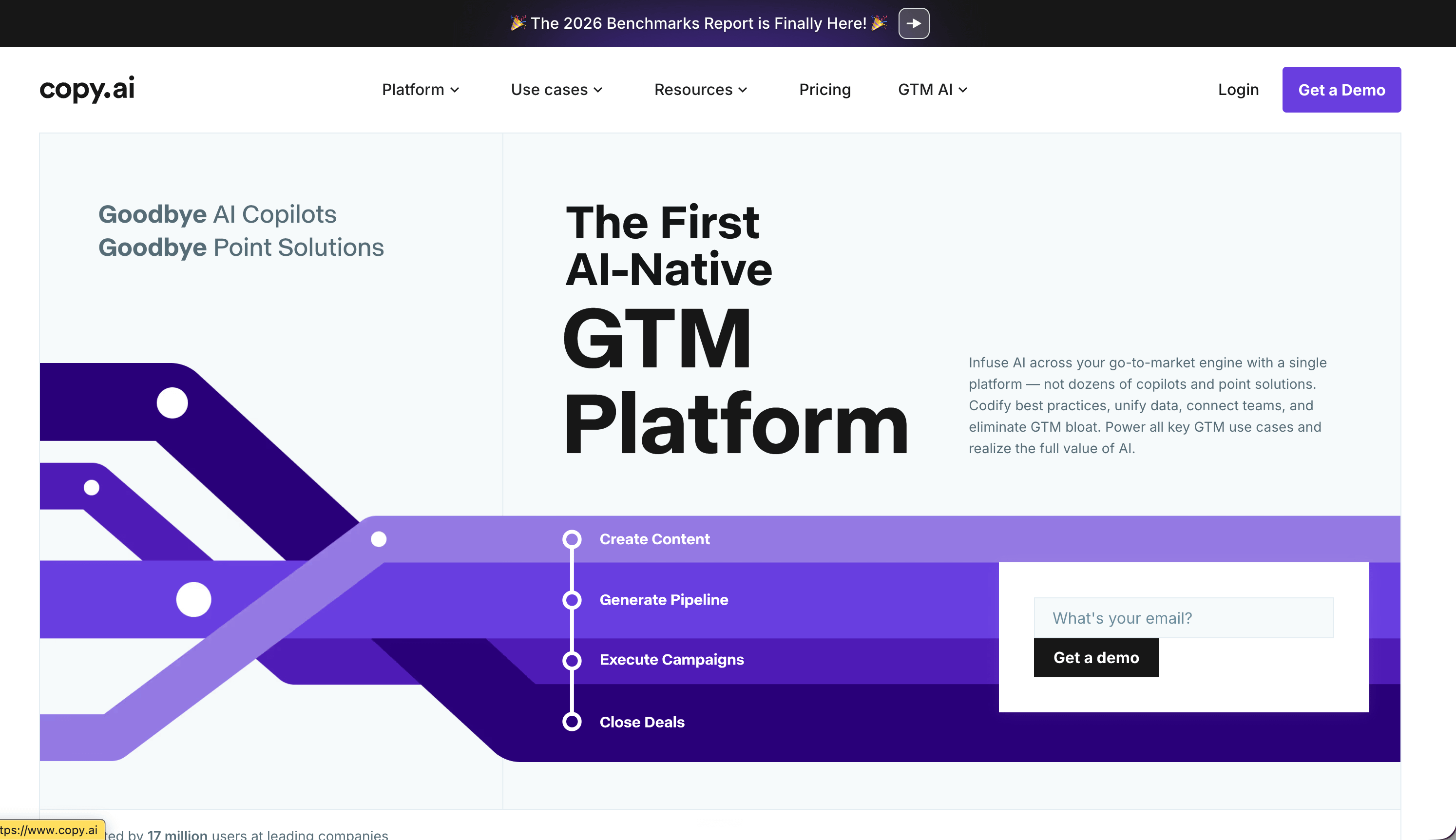
Go to Copy.ai’s homepage right now. You won’t find “AI copywriting.” You won’t see anything aimed at the solo marketer piecing together a content calendar at 11pm. What you’ll find is a platform for “GTM AI,” sales automation, and eliminating what they’re now calling “GTM Bloat.”
In October 2025, that position became permanent when Fullcast acquired Copy.ai, explicitly positioning the combined company as “the first end-to-end AI-native RevOps platform uniting planning, execution, and intelligence.” That’s a long way from a scrappy tool that helped a person write better cold emails.
This isn’t a criticism of Copy.ai. Strategically, the move makes complete sense.
Copy.ai reported 480% revenue growth in 2024, and the engine driving that wasn’t solo creators on $29/month plans. It was enterprises adopting AI workflows at scale, with customers like ServiceNow and Lenovo showing up in CEO Paul Yacoubian’s growth updates.
When your fastest-growing cohort is enterprise, you build for enterprise. But when a tool built by and for small teams makes that turn, it exposes a structural force that’s been reshaping the software industry for years, and it hits lean teams harder than most.
The pattern Copy.ai followed isn’t new
It’s the same arc Mailchimp traced after the Intuit acquisition, the same pull that moved Drift from scrappy conversational marketing tool to enterprise ABM platform, the same gravity slowly reshaping HubSpot from “CRM for small businesses” into a multi-hub enterprise suite with pricing to match.
The economics are almost embarrassingly simple.
A single enterprise deal at $5,000+/month typically eclipses what you’d collect from over 100 SMB subscribers. Enterprise customers sign multiyear contracts, churn less, and have dedicated procurement processes that create stickiness.
SMB customers, on the other hand, are volatile by nature. Small businesses fail, founders pivot, solo marketers switch tools the moment something shinier appears. The unit economics of serving SMBs are genuinely brutal, and the only way to make them work is either enormous scale or radical operational efficiency.
Most software companies choose neither. They move upmarket instead. And what makes the current AI wave different is the speed of that migration.
The generative AI market is projected to reach $85 billion by 2029, growing at roughly 40% annually. That growth is attracting capital, talent, and ambition — all of which align on the same target: enterprise RevOps and GTM platforms where deal sizes justify the AI infrastructure costs. When LLM usage fees are a real line item in your cost structure, you need customers who can absorb that cost at scale. An enterprise customer spending $50,000/year can. A freelancer on a $29/month plan cannot.
The result is a systematic hollowing-out of the SMB software stack. Tools that small teams adopted early, tools that shaped how they think about their workflows are getting repurposed for buyers with bigger budgets and more complex problems.
The hidden tax of enterprise-oriented tooling
When a product roadmap orients around enterprise RevOps, the burden on small teams compounds in ways that don’t show up on a pricing page. Because you’re not just losing features you wanted. You’re gaining complexity you don’t need, configuration overhead you can’t afford, and an implicit assumption baked into the product that you have a dedicated ops person to make it work. Most lean teams don’t.
When enterprise GTM needs drive a platform’s roadmap, small teams inherit complexity they did not ask for.
So they pay the subscription, fight the interface, and spend more time configuring than they would have with a simpler, more opinionated tool.
Analysis from Harvard Business Review frames this exactly right from the lens of productivity. For instance, the real cost of an AI writing tool isn’t the subscription price. It’s the total cost of editing — the hidden labor expense of fixing generic, inaccurate, or off-brand output.
Going back to our previous example: When enterprise GTM needs drive a platform’s roadmap, writing quality for small teams doesn’t just stagnate; it often regresses. This happens because engineering resources are poured into pipeline modeling and territory planning, rather than optimizing copy generation for a 500-word blog post.
A solo marketer who adopted Copy.ai in 2021 built their content workflow around specific assumptions: fast output, decent quality, minimal configuration. When the tool’s architecture shifts toward multi-team GTM orchestration, those assumptions break.
New features appear that require connecting to a CRM they might not have, or configuring approval workflows for a team of one.
The pricing tier that used to cover their needs now sits below a paywall built for enterprise budgets. Support documentation, tutorials, product announcements — all of it addresses a RevOps director, not them.
The workflow-vs-content bottleneck problem
There’s a more nuanced version of this that gets missed in most “SMBs abandoned” coverage. For instance, from a product perspective, not every small team’s primary constraint is content quality.
Some teams drown in coordination failures:
unclear priorities
approval chaos
inconsistent brand voice across channels
For those teams, a well-designed workflow system matters more than a better writing model.
And that complicates the clean “enterprise bad, SMB good” narrative.
A lean team running a high-velocity B2B SaaS company with a complicated content calendar might genuinely benefit from some enterprise-style workflow discipline, even if the packaging and pricing weren’t designed with them in mind.
The question isn’t whether workflow systems have value for small teams. They do.
But here’s the thing: is an enterprise RevOps platform the right tool for a three-person marketing team whose biggest challenge is getting a landing page out the door before next Tuesday? Especially when that platform was built for a VP of Sales managing a 50-person team, with a CRM, data warehouse, and dedicated ops hire.
Building for one could actively degrade the experience for the other.
That’s because enterprise products assume role specialization. The product’s mental model assumes different people own different parts of the system.
But when a solo marketer or a two-person team tries to use that product, they are doing work the product wasn’t designed to support efficiently, navigating an interface built for handoffs between specialists rather than for one person moving fast across the entire function.
The contrarian case (and why it’s partially right)
There is a fair counterargument: enterprise AI platforms may eventually create patterns that trickle down to smaller teams.
But history suggests that once enterprise revenue becomes the center of gravity, simplification for SMBs becomes something vendors maintain, not something they actively develop.
The SMB experience is maintained, not developed.
The dangerous gap between capability and execution
Access to AI features is not the same as having a marketing system that works.
A solo marketer with ChatGPT, a Canva subscription, a Mailchimp account, and a basic WordPress site has AI capability. What they don’t have is a connected system that runs strategy, positioning, content, and distribution as a single integrated function rather than a series of disconnected manual steps.
Enterprise teams can afford to hire the people who wire those pieces together: marketing ops managers, RevOps analysts, content strategists, demand gen specialists whose full-time job is building and maintaining that infrastructure.
Lean teams have none of that. They have a founder who needs to close a pipeline gap, a solo marketer covering four jobs simultaneously, or a small team trying to compete against companies with ten times the marketing headcount.
The enterprise pivot of tools like Copy.ai doesn’t just leave those teams without a specific feature. It leaves them without the infrastructure layer those tools were quietly providing: the opinionated defaults, the tight integrations, the simplified interfaces that made sophisticated marketing accessible without a dedicated ops function to configure them.
When a lean team loses a well-designed tool, they don’t simply substitute another well-designed tool. They patch together a collection of partial solutions that each solve one piece of the problem while creating new friction at every handoff point.
Output degrades. Time costs increase. And because none of those partial solutions have a coherent opinion about how marketing should work, the team defaults to whatever requires the least coordination — which is usually the highest-volume, lowest-quality content strategy available.

The strategic work gets squeezed out by the operational burden of managing a broken stack.
As enterprise vendors consolidate their positions with larger customers, the tooling available to small teams will increasingly fall into two categories:
Complex enterprise platforms priced beyond most SMB budgets
Cheap commodity tools with minimal strategic scaffolding.
Neither serves a lean team that needs to run a full marketing function without hiring a department.
Where the SMB marketing software market goes next
By 2028, the SMB AI marketing software market will split cleanly into two categories that together displace the current generation of “almost enterprise” tools serving neither segment well.
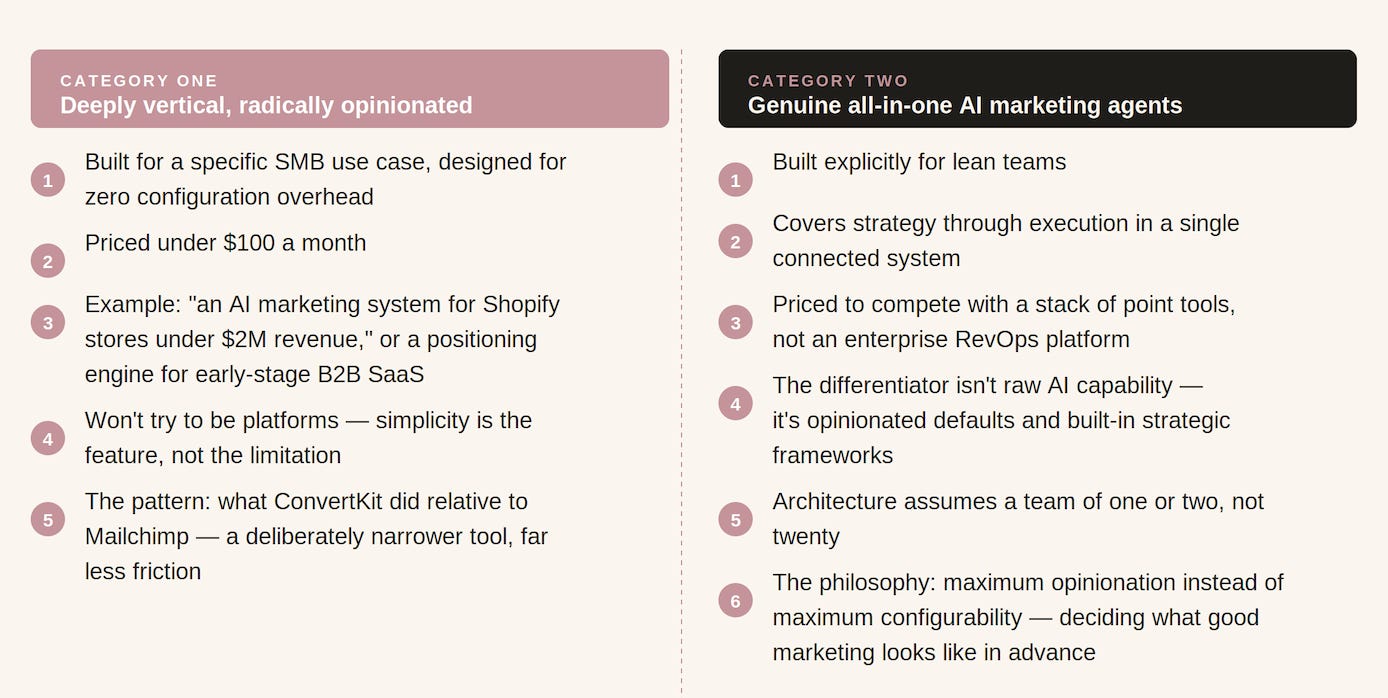
Category one: Deeply vertical, radically opinionated tools
These are built for a specific SMB use case, designed for zero configuration overhead, priced under $100/month. Think “AI marketing system for Shopify stores under $2M revenue” or “content and positioning engine for early-stage B2B SaaS.” These tools won’t try to be platforms.
They’ll do one thing extremely well for a specific buyer, and their simplicity will be a feature, not a limitation. The analogy is what ConvertKit did relative to Mailchimp: not a better version of the same thing, but a deliberately narrower tool that served creators with fewer features and far less friction. Vertical AI marketing tools will follow that same pattern, with a tighter AI-native architecture underneath.
Category two: Genuine all-in-one AI marketing agents
These are built explicitly for lean teams, covering strategy through execution in a single connected system, at a price point that competes with a stack of point tools rather than with enterprise RevOps platforms.
The differentiator won’t be raw AI capability — that’s getting commoditized fast. It’ll be opinionated defaults, built-in strategic frameworks, and an architecture that assumes a team of one or two rather than a team of twenty.
The product philosophy is the inverse of enterprise: instead of maximum configurability, maximum opinionation. Instead of presenting every option, deciding what good marketing looks like for a company at this stage and making most of those decisions in advance.
The tools currently trying to serve both SMB and enterprise, repricing for enterprise while still claiming to serve small teams will lose ground in both directions.
Enterprise buyers will consolidate onto purpose-built RevOps platforms with deep integrations and dedicated implementation support. SMB buyers will migrate to tools designed around their constraints, where the product’s assumptions match the reality of a small team rather than working against it.
You can test this in three years by looking at the top-ten AI marketing tools used by companies under 50 employees. If the list is dominated by simplified modules inside enterprise suites, this prediction is wrong. If it’s dominated by opinionated, SMB-native tools with SMB-native pricing, the market played out as expected.
For instance, community forums like r/Airtable are already full of users actively looking for Airtable alternatives that do what Airtable used to do before the pivot — that’s a demand signal.
All this to say, the vendors who will win that second category won’t be the ones who build down from enterprise complexity. They’ll be the ones who start with the constraints of a lean team and build up from there:
What does a three-person company need to run a full marketing function without hiring a department?
What do you get right when you design for that constraint first, rather than as an afterthought?
That’s a different product philosophy, and it produces a different product.
The Copy.ai acquisition made it clear that the current generation of AI marketing tools has picked its winner, and it’s not the solo founder trying to build a pipeline before their next funding round. The question now is who builds for that person instead and whether they have the discipline to stay focused on that problem when the enterprise money starts knocking.
Another disclosure, since it’s relevant to everything above: I have a stake in this prediction. I’m building Tenet, an AI marketing agent for lean teams, the exact shape of “category two” described here. That said, I didn’t write this piece to set up that pitch; Tenet’s my bet that the thesis above is right.