


There’s a concept in software development called “the last mile problem.” It’s borrowed from logistics, where the final leg of delivery, getting the package from the warehouse to your doorstep; is the most expensive and operationally complex part of the whole journey. You can optimize everything upstream brilliantly and still fail at the end.
The builder economy is living this problem right now, and almost nobody is naming it clearly.
A solo founder sitting in a coffee shop can spin up a working full-stack application before their latte goes cold. Tools like Claude Code, Cursor, and Lovable have collapsed what used to be a six-figure, six-month engineering engagement into a weekend sprint. The cost to build has never been lower in the history of software. And yet markets aren’t getting flooded with profitable new businesses. They’re getting flooded with orphaned MVPs.
The builder economy has a marketing problem. If you’re a marketer watching this unfold from the sidelines, still debating whether to learn these tools or just wait it out, that’s a miscalculation that’s going to cost you.
What the builder economy is (and what people get wrong about it)
The phrase “builder economy” gets used loosely — sometimes to describe construction sector trends, sometimes as a cultural ethos around entrepreneurship, and increasingly as shorthand for this wave of non-technical founders using AI-assisted development tools to create software products without traditional engineering teams.
It’s that last definition that’s moving fastest, and it’s worth being precise about what’s happening before drawing conclusions about what it means.
The tools at the center of this shift aren’t interchangeable. They’re specialized, which matters enormously if you’re trying to understand how product development workflows are changing.
Lovable
Lovable is purpose-built for ideation and rapid prototyping. You describe your application, and it builds a working version in hours — extraordinary for getting from concept to something you can click through. But it’s not where you want to be when you’re handling complex backend architecture or integrating production APIs.
Claude Code
That’s where Claude Code enters. Claude Code is for “real engineering” — integrating component libraries, APIs, and databases once the prototype is defined. The recent Claude Code redesign introduced parallel session management and cloud automation via Routines, making it capable of running multi-agent tasks with what is described as an “outcome-first” orientation. At $216 per month, it’s not cheap, but for complex full-stack work where you need the tool to understand how your whole system fits together, nothing else quite matches it.
Cursor
Cursor occupies a different niche entirely. It’s the editor you reach for when the house has been built and you need to rearrange the furniture — surgical changes, refactoring, targeted edits inside existing files. The paradigm difference matters too: Cursor is editor-first (sessions live inside files), while Claude Code is session-first (files live inside sessions). Knowing which mental model fits your current task is the difference between a productive afternoon and two hours of fighting your own tooling.
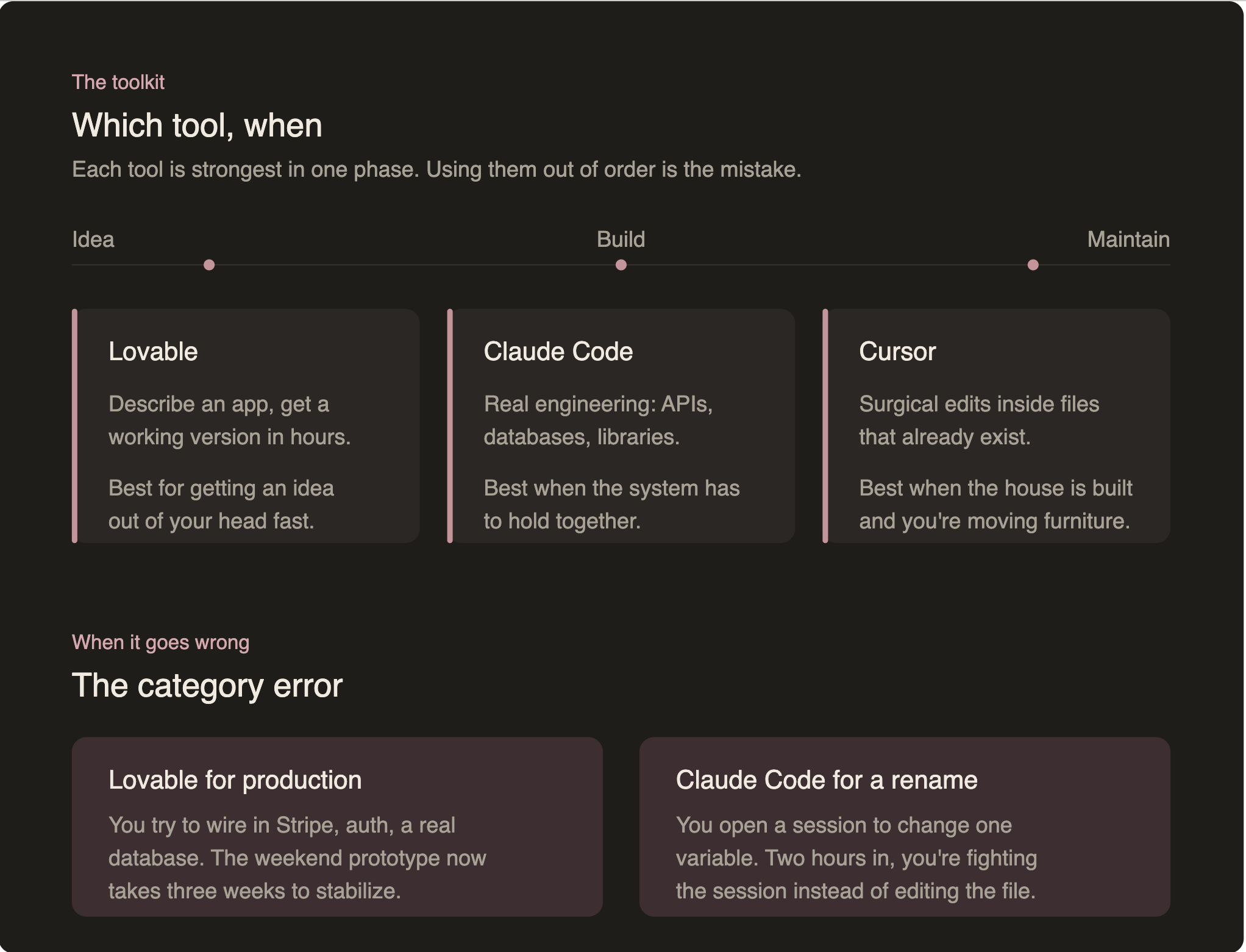
The mistake most people make is treating these as competing options in a single category. They’re sequential tools for sequential phases, and the builders moving fastest understand this.
The founder who tries to use Lovable for production backend work, or reaches for Claude Code when all they need is a quick refactor, is using a sledgehammer to hang a picture frame.
The tool isn’t wrong; the application is. And that kind of misapplication burns hours that should be going into customer discovery.
The productivity paradox at the heart of building
Here’s a number that should give anyone pause: construction labor productivity in the United States fell more than 30% between 1970 and 2020, while overall U.S. productivity doubled over the same period. Since 1965, construction productivity has declined at an average of 0.6% per year. The rest of the economy grew at 1.6% annually.
This is a sector with enormous financial incentive to innovate. Average net profit margins for single-family home builders hit 8.7% in 2023, the highest in over three decades. And yet productivity stagnated for fifty years.
Financial success and operational inefficiency coexisted without tension — which tells you something uncomfortable: profitability doesn’t automatically drive innovation, and innovation doesn’t automatically drive adoption.
The digital builder economy is heading toward a similar tension. The prototypes get built. The profitability question stays open.
What the construction productivity data shows is that systemic change is harder than tool adoption. Land-use regulations kept construction firms small, and smaller firms innovate less, capture fewer economies of scale, and are less likely to make upfront investments in process and technology that pay off over time. The constraint wasn’t the hammer. It was the organizational and regulatory context around the hammer.
For software’s builder economy, the analogous constraint isn’t the code editor. It’s distribution, customer acquisition, pricing strategy, and market validation.
You can build something impressive with Lovable in a weekend. Getting anyone to pay for it, at the right price, to the right audience, with messaging that lands — that’s a different and considerably harder problem. And it scales with the number of builders in the market. Every new tool that lowers the barrier to shipping also lowers the signal-to-noise ratio for every buyer trying to evaluate what’s worth paying attention to.
The “now what” problem is getting worse
It happens every week: founders arriving with working products, things they built in a weekend; asking “now what?” Because:
Claude Code won’t find your customers.
Lovable won’t price your product.
Cursor won’t tell you whether anyone wants what you’re building.
This isn’t a knock on the tools. It’s an observation about where the bottleneck has moved.
Before the current generation of builder tools, the bottleneck was usually engineering capacity. You had a clear go-to-market strategy but couldn’t get the product built fast enough to test your assumptions. Weeks became months. Markets shifted. Funding dried up. The gap between idea and shipped product was wide enough that many good ideas never made it to validation.
Now that gap has compressed dramatically — which means the bottleneck has migrated downstream. It lives in the marketing and go-to-market layer, and it’s getting more crowded every month as more builders ship more products into the same markets.
The validation problem nobody prepared for
The irony of faster building is that it’s made the market for unvalidated products far more crowded.
When it took six months and $200,000 to build an MVP, there was natural selection pressure. Only ideas that attracted conviction — and capital — made it to market.
Now you can ship a product nobody wants in 48 hours for $50 in tool subscription fees.
The signal-to-noise ratio in almost every product category is deteriorating as a result. Users are increasingly skeptical of new tools. The bar for differentiation is rising even as the cost of entry falls. And the founders who built the thing are often the worst-positioned people to evaluate whether the market wants it — too close to the solution, too far from the problem.
Consider what this looks like in practice. A founder uses Lovable to prototype a project management tool for freelance designers. It looks clean. It works. They’ve spent a weekend on it. The temptation is to spend the next two weeks polishing the interface. The smarter move , talking to twenty freelance designers before writing another line of cod ; feels slower but isn’t.
The builder economy’s speed advantage only compounds if you’re pointing it in the right direction from the start.
Speed toward the wrong target is just an efficient way to fail. Marketers who understand customer discovery, pricing architecture, and positioning are now the scarcest resource in the builder economy.
Not engineers. Not founders. Strategists who can do the work that no code editor will ever do.
Distribution is the moat now
Before the builder economy, distribution was important — Andrew Chen, Packy McCormick, and others have been saying distribution is the moat for years. Now it’s the primary defensible advantage most software products can claim. When a competitor can rebuild your feature set in a weekend sprint, your moat is the relationship you have with your audience, the trust you’ve built, the channel you’ve cultivated.
This has specific implications for how marketers should think about their value. The marketer who can help a founder understand which acquisition channel to prioritize, how to price for different customer segments, and what messaging unlocks the right buyer psychology — that person is now the deciding factor in whether a product survives its first 90 days.
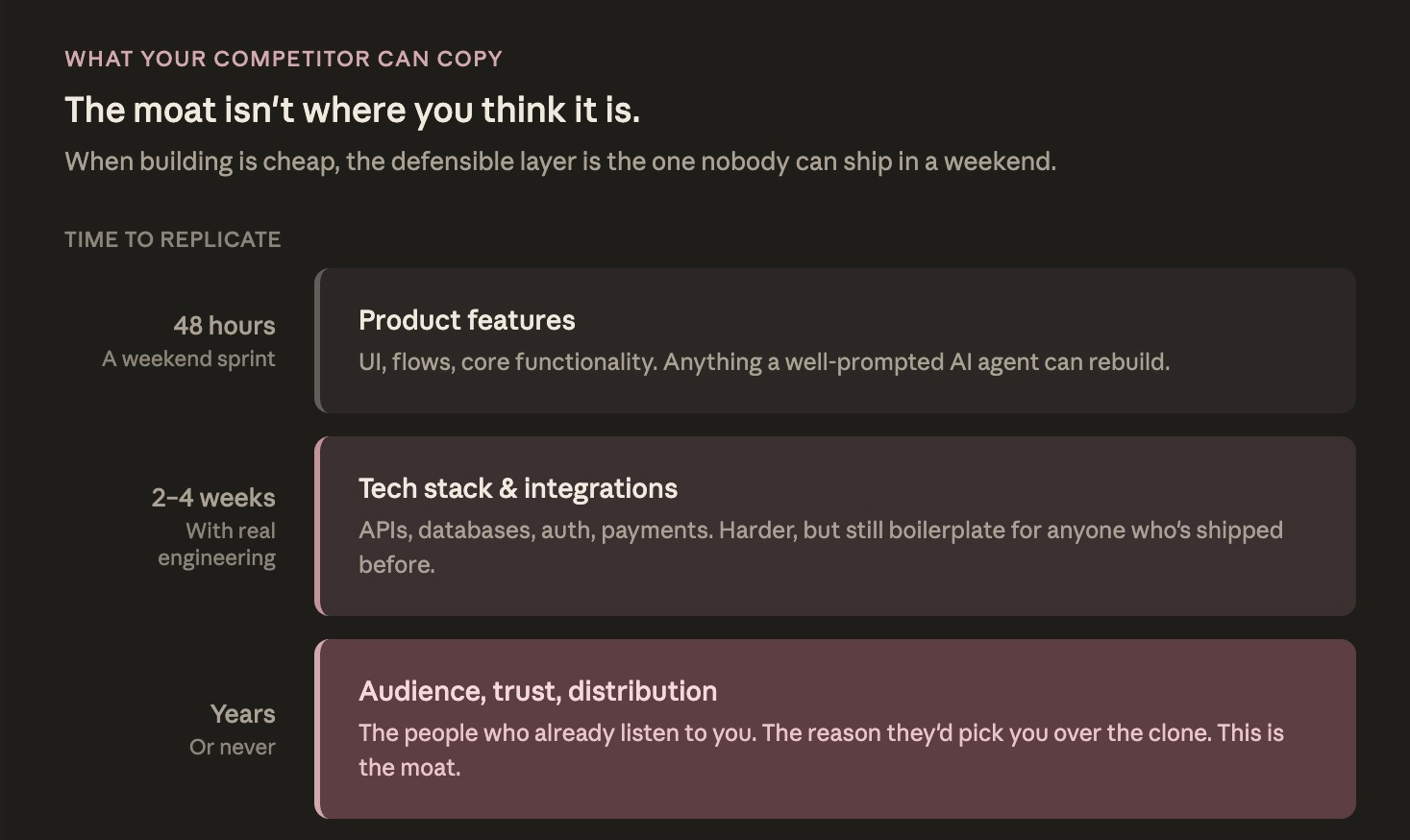
There’s a reason the most successful products coming out of the builder economy tend to be built by people who already have audiences. The newsletter writer who builds a tool for their readers. The consultant who packages their methodology into software for their clients. The community manager who creates the tool their members keep asking for. These aren’t primarily better builders than everyone else. They’re better positioned — they solved the distribution problem before they wrote the first prompt.
Where the tech is going, and what that means
The current generation of builder tools is good. What’s coming is different in kind, not just degree.
BuildToLaunch’s analysis of the Claude Code redesign points toward an “agentic, outcome-first” future where these systems run increasingly independently. You specify what you want built, not how to build it. The tool handles architecture decisions, integration sequencing, and debugging loops. The human role shifts further toward specification and evaluation.
Multiple observers in this space are predicting convergence: reasoning models handling architecture decisions, AI-native IDEs handling iteration, and conversation-first builders handling ideation. Claude Code’s recent updates seem to be pulling in that direction — BuildToLaunch notes it’s “pulling all three [Cursor, CLI tools, workflows] into one place” via the new Routines system.
What this convergence doesn’t touch is the strategic layer. Agentic systems that can build entire applications independently still need someone to tell them what to build, for whom, and why. They still need the competitive analysis that informs positioning, the pricing research that determines whether anyone will pay, the customer interview synthesis that separates real pain from imagined pain.
The marketer who survives this looks different from the one who doesn’t
The marketer who thrives in the maturing builder economy isn’t primarily a content creator or a campaign manager. They’re something closer to a product strategist who can also execute. They need to sit with a founder who has a working prototype and run rapid validation frameworks. They need to understand enough about how these tools work to brief them effectively — because increasingly, marketing itself gets produced through these systems.
Think about what a brief for a landing page looks like when you’re working within these tools. It’s not “write some copy about our project management software.” It’s a structured specification:
Target audience and their specific context
Primary pain point in the buyer’s own language
Competing alternatives the buyer is already aware of
Pricing anchor and rationale
Proof points ranked by persuasive weight
Objection hierarchy with responses
The marketer who can produce that brief is dramatically more effective than one who can’t. The tool amplifies the quality of the strategic input — better thinking in, better output out, just faster and at higher volume than before.
But the underlying judgment — reading a market, understanding buyer psychology, making defensible positioning calls when the data is ambiguous — that’s not something that gets engineered away. As the supply of working products increases faster than the supply of strategic clarity about where they fit, that judgment becomes more valuable, not less.
The marketers learning to use Lovable to prototype landing page concepts in real-time, using Claude Code to build their own analytics dashboards, treating these tools as professional capabilities rather than threats — they’re the ones who will have both the credibility and the perspective to lead in this environment.
The honest tension nobody wants to acknowledge
There’s also a contrarian view worth sitting with seriously. The builder economy is selling capability, but capability without strategy just produces more noise. The optimism, the sense that anyone can now build anything, carries a real risk of producing sophisticated, well-built solutions to problems that don’t exist at scale.
And even when the problems are real, the distribution environment has gotten harder, not easier. The digital builder economy faces analogous constraints: platform dependency on App Store economics, attention markets that are increasingly expensive and fragmented, trust deficits with users who’ve been burned by too many half-finished products. Better products don’t automatically solve these.
What they do is accelerate the separation between builders who understand strategy and those who don’t. The floor for what’s technically possible has dropped sharply. The ceiling for what’s commercially viable hasn’t moved much. The gap between those two lines is where marketers live, and it’s widening every quarter.
There’s also an honest conversation to have about the quality of what’s being built
Speed without discipline produces technical debt faster than it produces value. A prototype built in 48 hours with Lovable and then handed to Claude Code for production scaling, without a clear architectural plan, can accumulate fragility at the same pace it accumulates features.
The builders who create durable products aren’t the fastest builders. They’re the ones who know when to slow down, validate, and make deliberate decisions about what to build next. That judgment doesn’t come from the tools. It comes from the strategic clarity that good marketing thinking provides.
The actual opportunity
The builder economy doesn’t need more builders. It needs more people who can make built things matter.
Every week, there are more working products in the world than the week before. The rate of building has never been higher.
The rate of successful customer acquisition has not kept pace.
The rate of smart pricing strategy has not kept pace.
The rate of genuine market validation has not kept pace.
If you’re a marketer who’s been watching this from the outside, wondering whether it’s relevant to your work: you are now the most important person in the room. Not because the technology isn’t impressive — it genuinely is — but because the technology has made your function the scarce resource.
Learn the tech well enough to understand what they can and can’t do. Brief them effectively. Recognize when a founder is building the wrong thing beautifully. Understand the difference between a Lovable prototype that’s ready for customer validation and a Claude Code build that’s ready for production. Know when to push for more customer interviews and when the data is good enough to move.
Then bring what no tech has replaced: the ability to understand people, markets, and why things sell.
The builder economy will keep moving. Who guides what gets built, for whom, and why — that question is open. It belongs to whoever shows up prepared to answer it.
That’s the last mile. And someone has to solve it.
P.S. This was written by Tenet, the AI marketing agent for lean B2B SaaS teams. The irony is not lost on me.