

In 1929, G.K. Chesterton told a story about a fence.
A reformer encounters a fence crossing a road and declares, "I don't see the use of this; let us clear it away." The wiser man responds, "If you don't see the use of it, I certainly won't let you clear it away. Go away and think. Then, when you can come back and tell me that you do see the use of it, I may allow you to destroy it."
There are many things that seem broken in marketing. But when you’re building a product, you have to constantly ask: is this actually broken, or does it just look inefficient from the outside?
Because to build anything that lasts, you need to understand what the fence was protecting, and who gets hurt when it comes down. History is littered with reformers who ignored this wisdom and paid catastrophically.
The Four Pests campaign: A lesson in reckless reform
In 1958, China launched the Four Pests campaign during the Great Leap Forward. Sparrows were designated enemies of the state, accused of stealing grain that could feed humans. The logic seemed airtight: eliminate sparrows, save crops, reduce hunger.
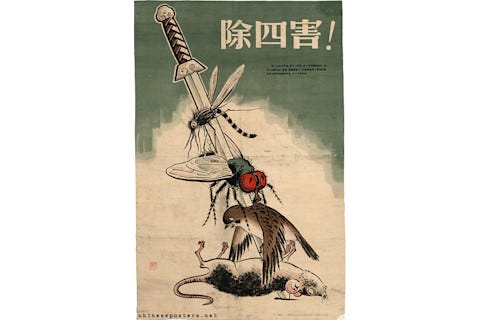
“Exterminate the four pests!” A 1958 poster by Ding Hao.
Image: International Institute of Social History/Stefan R. Landsberger Collections.
Millions of sparrows died in a coordinated national effort. Citizens banged pots and pans to exhaust birds until they fell from the sky. The campaign succeeded brilliantly at its stated goal.
Then the locusts came.
Without sparrows to control insect populations, locust swarms devoured crops across the country. The ecological collapse contributed to a famine that killed between 15 and 55 million people. The fence of natural predator-prey relationships had served a purpose that reformers never bothered to understand.
This pattern repeats in business with depressing regularity. A VP inherits a sales team that refuses to close deals under a certain contract value. It looks like lost revenue, so they remove the rule. Eighteen months later, the company is drowning in small accounts that cost more to service than they generate.
Marketing’s mysterious fences
A fence, in Chesterton’s sense, is any practice, rule, or system that looks unnecessary until you understand what it was built to prevent.
Marketing is riddled with practices that seem wasteful to the untrained eye:
Long sales cycles when customers could buy immediately.
Emotional storytelling when features and benefits should suffice.
Human relationship-building when algorithms could match buyers to sellers instantly.
The pattern is consistent: reformers see inefficiency, apply their logic, optimize the obvious metric, and unleash unintended consequences that dwarf the original problem.
But here’s the thing: These fences didn’t emerge randomly. They evolved as solutions to fundamental problems that persist whether we acknowledge them or not.
1. The trust signal fence
Consider the elaborate rituals of B2B marketing: white papers, case study testimonials, multi-touch email sequences, personal demos. From an efficiency standpoint, this looks absurd. Why not just state the benefits and close the deal?
The fence exists because strangers lie.
In a world where anyone can build a professional-looking website and manufacture social proof, buyers learned to look for expensive signals: content that required real investment, relationships that took time, proof that was hard to fake. The inefficiency was the point.
The peacock’s tail principle applies here. Male peacocks don’t grow elaborate plumage because it helps them survive; it’s quite the opposite. The tail is costly and cumbersome, which makes it valuable as a signal. Only genuinely fit peacocks can afford such extravagance, so peahens use it as a reliable indicator of genetic quality.

Business works the same way. A company that invests months nurturing prospects through educational content signals confidence in their solution and respect for the buyer’s decision process. A founder who takes personal sales calls signals that customer success matters more than scalability. These costly behaviors became trust proxies precisely because they’re hard to fake.
Now AI promises to make every signal cheap. What happens to the fence then?
2. The attention scarcity fence
Marketing’s second major fence addresses a problem that predates digital advertising: human attention is finite and valuable. Traditional marketing developed elaborate mechanisms to earn and hold this attention, i.e., compelling narratives, memorable branding, community building, and content that provided genuine value beyond sales pitches.
These practices look inefficient compared to programmatic advertising that can target ideal customers with surgical precision. So why invest in brand storytelling when you can buy clicks from people already searching for your solution?
The fence exists because attention without context is worthless.
Research shows that while AI-powered ad targeting has boosted click-through rates, improvements in actual purchase behavior depend heavily on whether customers trust the brand behind the ad. Customers click more ads but buy at similar rates, suggesting that precise targeting without trust-building creates engagement without commitment.
The attention scarcity fence forced marketers to earn their audience rather than simply buying access. Content marketing, thought leadership, and community building emerged as solutions to a fundamental problem: people ignore messages from sources they don’t trust or find valuable.
AI can certainly optimize for engagement metrics, but optimizing for the wrong thing often makes the real problem worse. If the goal is lifetime customer value rather than this quarter’s pipeline, then many traditional “inefficiencies” are worth preserving.
3. The measurement gap fence
Perhaps marketing’s most frustrating fence is the measurement problem. Traditional marketing invested heavily in activities with unclear ROI, such as brand awareness campaigns, thought leadership content, relationship building, and customer success programs that extended far beyond the initial sale.
Modern marketing tools promise to close these gaps with attribution modeling, customer lifetime value calculations, and AI-powered analytics that track every touchpoint from first impression to final purchase.
But the fence exists because some value can’t be measured directly.
When Bain & Company and the LinkedIn B2B Institute analyzed B2B buying groups, they found that deals succeeded 81% of the time when the entire buyer group already knew the brand, compared with just 4% when only the recommending function knew it. This brand familiarity acts like “deal risk insurance” for buyers and is nearly impossible to attribute to specific campaigns or content pieces.
Companies that invest in genuine thought leadership often see benefits that appear in financial statements years later, when employees recruited through content become top performers, or when strategic partnerships emerge from relationships built through industry presence.
The measurement fence forced marketers to think long-term and invest in compound effects rather than optimizing for immediate, trackable returns.
When the old fences fall
AI didn’t ask permission to dismantle the fences we just described. It made them cheaper, one by one, until the cost that made them meaningful disappeared. White papers that took months now take hours. Campaigns that required teams now require prompts. Every signal that once said “this company invested in being taken seriously” is now available to everyone, instantly, for almost nothing.
Most companies look at this and called it progress. But buyers, as they always do, are already adapting.
1. Taste and judgment
In 1979, the French sociologist Pierre Bourdieu published Distinction, a book on how taste works in society. His central argument was radical for its time: taste is not natural, not innocent, not personal. It is cultivated. And crucially, it classifies, not just the things being judged, but the person doing the judging.
“Taste classifies,” Bourdieu wrote, “and it classifies the classifier.”
What he meant was that the ability to distinguish good from bad — in art, in food, in ideas — is itself a form of capital. It is earned through exposure, through failure, through years of being inside something long enough to develop a sense of what is worth taking seriously and what isn’t. You cannot acquire it quickly. You cannot fake it reliably. And in a world where everything else can be produced cheaply, it becomes the signal that everything else was pointing to.
This is what AI has surfaced in marketing. When every company can produce polished content, relevant messaging, and credible-sounding thought leadership, the question buyers are left with is the one Bourdieu was really asking: does anyone behind this actually know what they’re looking at? Not “is this well made” (AI has solved that) but “did someone with genuine judgment decide what was worth making in the first place?”
The fence isn’t production anymore. It’s discernment in the original sense of the word. The ability to tell the difference.
2. Conviction
In the 1920s, John Maynard Keynes was managing the endowment of King’s College, Cambridge. Every other university endowment of the era invested almost exclusively in land and fixed income; it was safe, stable, conventional. Keynes bought equities, international stocks, and commodity futures. His colleagues thought he was reckless. He outperformed the UK market by more than six percent annually for decades.
He wasn’t smarter than the other endowment managers in any narrow sense. He was willing to think against the grain of existing consensus because he had actually done the thinking and arrived somewhere different. The position was credible precisely because it was costly to hold.
When everyone around you is doing something else, being right requires not just an insight but the willingness to be wrong in public until you’re not.
This is the second fence AI cannot cross. A model trained on the entire history of B2B marketing will produce B2B marketing thinking that is perfectly calibrated to consensus because consensus is all it has.
It cannot arrive at the insight that contradicts the synthesis, the one that says this playbook everyone is running is the thing that’s about to stop working. That insight requires a mind willing to sit with discomfort long enough to see what the data hasn’t confirmed yet. It requires, in other words, someone who has something to lose by saying it.
3. Earned knowledge
In the 1840s, a Hungarian physician named Ignaz Semmelweis noticed something the medical establishment had missed: the mortality rate in the maternity ward staffed by doctors was three times higher than the ward staffed by midwives. He traced the difference to one thing — doctors came to deliveries directly from performing autopsies, without washing their hands. He proposed a solution. His colleagues dismissed him. The theory was rejected for nearly two decades because accepting it meant the entire medical profession had been killing patients.
Semmelweis saw what he saw because he was inside the problem in a way that implicated him too. The insight was inseparable from the vantage point. And the vantage point was inseparable from having actually been there — not read about it, not modeled it, but stood in the room long enough to notice what wasn’t supposed to be there.
This is what context means as a fence: the specific, accumulated, sometimes uncomfortable knowledge that comes from having been inside something long enough to notice what the data keeps missing. It is the thing that makes a contrarian position land as signal rather than noise because the person saying it could only be saying it from here.
Buyers have always been building new filters when the old ones stop working. They are doing it again now. And the question for every marketer who understand this are left asking a harder question: what am I bringing to it that it cannot generate on its own?